Microsoft 365 Subscribers 2026: 95 Million and Rising Bills
Microsoft will not tell you how many people pay for Microsoft 365 anymore. The last official figure was 89 million consumer subscribers in July 2025, and the estimate for mid 2026 is about 95 million. What Microsoft did report on July 29, 2026 is the part that reaches your wallet: Microsoft 365 consumer cloud revenue up 24%, well ahead of the 14% from business customers. Home and family subscribers are now Microsoft’s fastest growing source of cash, which is exactly why your renewal price went up.
Microsoft’s fourth quarter results, released July 29, 2026 for the quarter ended June 30, show Microsoft 365 Consumer cloud revenue up 24%, compare that with Microsoft 365 Commercial cloud revenue rose by a ‘mere’ 14%.
We’ve dug into the complicated reporting to try answering some simple questions like “How many individuals have Microsoft 365?”, “How many people pay for Copilot?” and “How much is spent on data centers?”
Microsoft 365 consumer sales have risen a lot
For the third year running, home and family subscribers are growing Microsoft’s revenue faster than businesses are. A 24% jump is a big number for a mature product line.
Microsoft does not explain why in the press release, but the arithmetic isn’t hard. Consumer revenue growth comes from three levers: more subscribers, higher prices, and pushing people to more expensive tiers. Microsoft has pulled all three.
The January 2025 price rise took Microsoft 365 Personal from US$70 to $100 a year and Family from US$100 to $130 a year, with a limited version of Copilot bundled in as the main justification. The newer Microsoft 365 Premium tier sits above both at a higher price again, US$200 a year. We’ve rounded all those prices to the nearest dollar.
Microsoft stopped counting consumer sales
One number you will not find in the latest press release is the Microsoft 365 Consumer subscriber count. It is not in the release text at all because Microsoft stopped giving that figure last year.
The last quoted number is 89 million Microsoft 365 consumer subscribers in July 2025.
When they did give a number, it wasn’t clearly defined. In their 2025 Annual Report (page 25), Microsoft 365 Consumer subscribers is defined as “The number of Microsoft 365 Consumer subscribers at end of period”. An unhelpful circular definition.
Microsoft is deliberately vague about what they are counting in their quoted number. It appears to be counting “billing relationships”, meaning each owner of a Microsoft 365 consumer plan. The Family and Premium plans count as one each, not including the sharing users linked to that plan.
Nobody outside Microsoft knows how trials and bundled subscriptions are treated. New PCs frequently ship with a one month or one year Microsoft 365 subscription included in the price. Because the definition omits the word “paid”, there is no public basis for saying whether those sit inside or outside the count.
The number includes the cheap Microsoft 365 Basic, which costs only US$20 a year. That started in 2024. The count makes no distinction between someone paying $20 a year and a Premium plan customer paying ten times more.
There’s no breakdown of the Microsoft 365 plans into counts for Basic, Personal, Family or Premium.
How many Microsoft 365 customers in 2026?
All we know for sure is that there were 89 million “Microsoft 365 consumer subscribers” stated in July 2025.
After that you can only infer the number based on the increased revenue. The best guess is around 94-95 million subscribers in mid-2026.
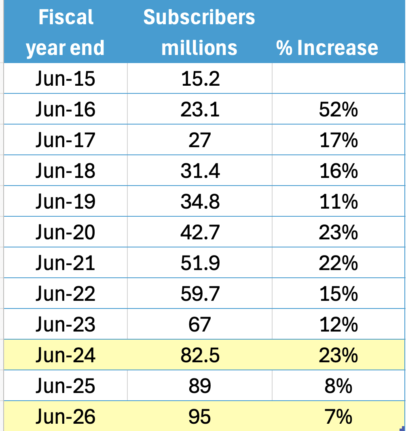
If that’s right, it might explain why Microsoft stopped giving a consumer subscriber number. A rise of 6 million customers or 6-7% in a year would be great for almost any business, but for Microsoft it’s a decrease from the massive (double-digit %) rises of previous years.
The company knows that Microsoft 365 sales are plateauing or nearing market saturation so they stopped quoting the number to try hiding that fact.
The rise of Microsoft 365 for consumers
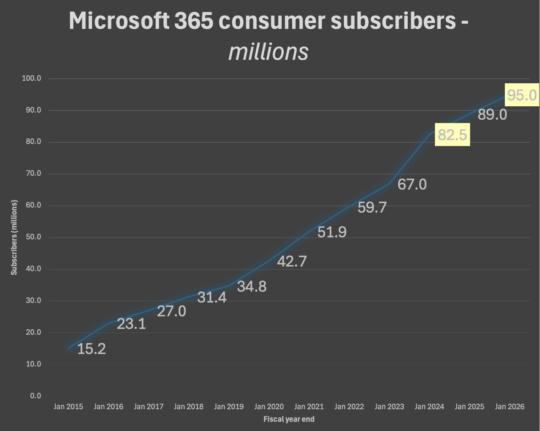
As you’d expect, Microsoft 365 consumer plans have grown enormously. Microsoft’s subtle and not-so-subtle push of Personal, Family and now Premium plans has paid off.
Notes:
The 2024 number (highlighted) included Microsoft 365 Basic for the first time, which explains the unusually high increase of 23%. Microsoft reported a 10% rise at the time.
2025 is the last time Microsoft quoted a number for “Microsoft 365 consumer subscribers”.
The 2026 number (highlighted) is an estimate only.
Copilot in less than 7% of users
30 million paid Microsoft 365 Copilot seats, up from 20 million in April, is genuine momentum.
But it’s not so good compared to the installed base. Microsoft has previously reported more than 450 million paid commercial Microsoft 365 seats.
That means fewer than one in fifteen commercial seats, or about 6.6%, have a paid Copilot license.
Microsoft also said hundreds of enterprise customers have bought millions of seats of the premium E7 tier, which is the vehicle Microsoft is using to bundle Copilot into the top end enterprise plans rather than selling it as a separate US$30 per user per month add-on.
Microsoft still does not disclose Copilot revenue on its own. It is folded into Microsoft 365 Commercial and consumer cloud lines, so nobody outside Redmond can say what Copilot actually earns.
Commercial sales not so great
On the Commercial side of Microsoft 365, Microsoft gives two numbers, and one of them is more flattering.
Microsoft reported that Microsoft 365 Commercial cloud revenue rose 16% once you strip out an unusual item in the same quarter last year. That item is worth about 2 percentage points.
A chunk of revenue landed in the same quarter last year that normally would have been spread out, which makes this year’s growth look smaller by comparison. Microsoft’s 16% adjusted figure might be a fairer comparison. The 14% is what actually happened in the accounts.
Both numbers are defensible. What is telling is that Microsoft chose to lead with the adjusted one. Commercial Microsoft 365 growth in the mid-teens is solid but it is no longer accelerating, and consumer is now growing considerably faster.
What about Office 2024?
Microsoft doesn’t disclose sales numbers for one off purchase versions of Microsoft Office, like Office 2024 or Office 2021, and probably never will.
There is no unit count, no revenue figure, and no market share number for Office 2024. Microsoft has not disclosed sales for a perpetual Office release since the Office 2013 era, and Office 2024 is no exception. Anyone quoting a specific figure is either estimating or making it up.
Perpetual Office is a rounding error in Microsoft’s results, which is just one reason why it gets no disclosure.
Microsoft frames perpetual Office as a legacy accommodation, not a product line it wants to grow or even refer to. The company would much prefer everyone have a more profitable Microsoft 365 subscription and forget about Microsoft Office completely.
Paying for data centers
Additions to property and equipment reached US$35.8 billion in the final quarter of Microsoft’s 2026 financial year, more than double the $17.1 billion a year earlier.
That is mostly the money Microsoft is spending on data centers, and subscription price rises are one of the places it gets paid back.
Microsoft 365 Plans Overview: Pricing and Features
Microsoft 365 Classic: The Hidden Plan for Consumers
Microsoft 365 price increases around the world
Microsoft 365 Premium Features and Pricing Explained
Microsoft 365 E7: a $99 “Frontier Suite”, the Future or an Expensive Bundle?
All about AI Credits in Microsoft 365
Microsoft 365 Business Plans Pricing and Inflation
Xbox Wants a Billion Daily Users: Why the Math Is Pure Fantasy