Copilot Saves “43 Minutes a Day”? The Real Number Is 12
Microsoft 365 Copilot saves UK NHS staff 43 minutes a day. That single number has been repeated by Microsoft and the UK government for a year, and it helped justify a Copilot deal for 505,000 National Health Service staff worth around £120 million. A Freedom of Information request has now revealed where the figure came from: just 86 self selected case studies, no actual measurement, and a report written by a firm that sells Copilot rollouts. Buried in the same document are much smaller numbers. If your own workplace is being sold Copilot on the strength of that or similar claims, here is what the evidence actually shows and what to ask before you believe any AI productivity claim.
A Freedom of Information (FOI) request, reported in Private Eye (issue 1682, page 21), has finally shown where the number came from. The boast turns out to be a very selective statistic with a great deal of detail left out..
It should not be a surprise to anyone that claims of AI benefits are overstated, especially by people trying to sell AI. It’s a pity because these extreme boasts can make people cynical about AI generally.
AI has a place when used carefully. Office Watch has written three books helping people wisely use AI, including Write better and faster with any AI.
The “time and cost savings” claim
In October 2025, the UK Department of Health and Social Care (DHSC) announced results from a Copilot trial across 90 NHS organizations involving more than 30,000 staff. The press release claimed “unprecedented time and cost savings”, specifically mentioning “Microsoft 365 Copilot”.
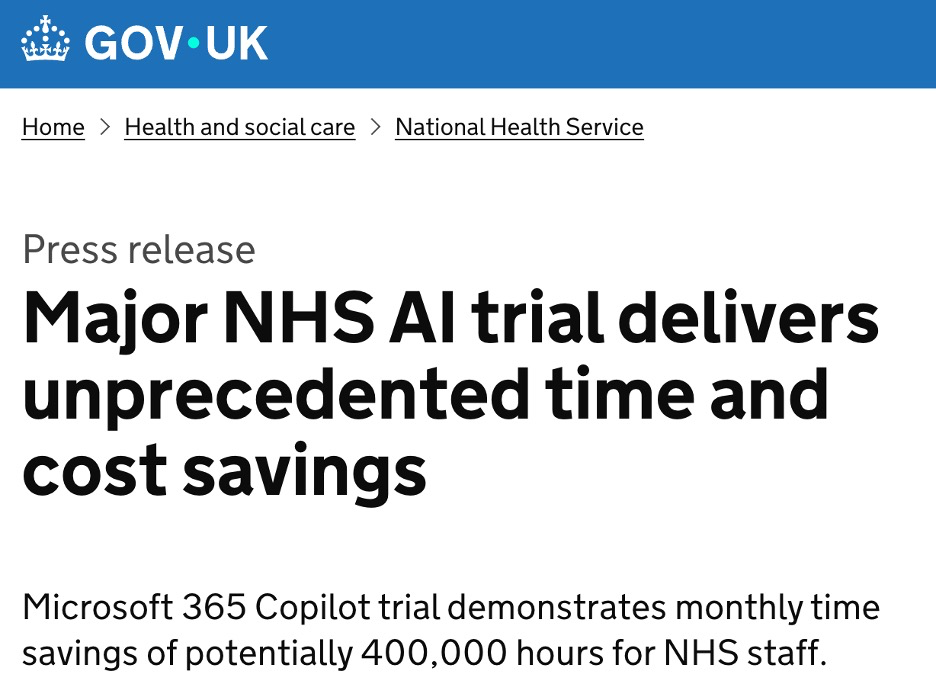
The headline finding: 43 minutes or more saved per staff member per day, which the DHSC converted into five weeks a year per person and up to 400,000 staff hours a month.
The methodology was never published, which is always a warning sign, especially for such an extreme claim.
Exploding the “43 minutes a day” claim
It is self-reported
Staff estimated their own time savings. Nothing was measured. Microsoft UK’s own statement in the original announcement says “a reported 43 minutes every day”. Many “facts” about AI savings come from self-reported surveys.
It comes from just 86 people
The figure is drawn from a mere 86 case studies, though the report contradicts itself and elsewhere says 69. That’s roughly one in 350 people (under 0.3% of the 30,000 participants) and the case studies are success stories nominated by the organizations taking part. That’s selection bias in its purest form.
The same report contains much smaller numbers
Savings of 33 minutes a day, and of 4 hours a month, appear elsewhere in the same document. Four hours a month is about 12 minutes a working day. Meanwhile 43 minutes a day works out at about 15.5 hours a month. The report contains two figures nearly four times apart, and the bigger one went into the press release.
Sales partner wrote the report
Accenture sells Copilot implementation to the UK government, is a major Microsoft partner, and deployed Copilot to its own 743,000 staff. The firm that produced the evaluation stood to profit from the rollout it justified.
More questionable Copilot “facts”
Other government departments have run Copilot trials and published their methods.
- HMRC, the UK tax office, used a randomized cohort design and strict measurement standards. Result: about 60 minutes per week, or roughly 12 minutes a day.
- The UK Government Digital Service trialed Copilot with more than 20,000 civil servants and reported about 26 minutes per day. However, this was another self reported survey, and it dates from late 2024 when AI tools were very different.
- Australia’s Treasury ran a 14 week trial and found staff rated Copilot less useful than expected. It was a small study of 218 people, run in mid 2024.
HMRC’s carefully measured 60 minutes a week is almost exactly the 4 hours a month figure buried inside the NHS report. The number the NHS chose not to publicize is the one that matches the more properly designed trial.
Before you believe the next AI productivity number
The 43 minutes figure is not a one off. Microsoft has a long habit of leading with the best available number, and we have been tracking it since the beginning in Microsoft Copilot reaches new levels of marketing hype. If you want the harder evidence that customers are not convinced, the price cuts and adoption figures in Copilot is not as popular as Microsoft says, Customers Aren’t Buying the hype tell a very different story to the press releases.
Self reported savings are one thing, accuracy is another. Our hands on testing in Copilot in Excel: Understanding the Limitations shows Copilot confidently returning incomplete lists in spreadsheet cells, and every single report we generated for Microsoft Copilot Deep Research: Pros and Cons contained factual errors. Time saved is worth nothing if you spend it checking the output.
Microsoft’s own lawyers are far more cautious than Microsoft’s own marketers. That contradiction is laid out in Microsoft Copilot Entertainment Purposes Only Explained, and the six further clauses that quietly move legal risk onto you are covered in Microsoft Copilot Terms of Use Warnings to Know.