Apple Takes Aim at Microsoft 365 and Google Workspace with Free Business Platform
Apple is entering the business productivity market and it is not charging a cent to do it. Starting April 14, 2026, Apple Business will be available in more than 200 countries as a free platform for companies of any size. It will eventually bundle email, calendar, directory services, built-in mobile device management (MDM), and Maps advertising into a single service under your own custom domain. Seems like the start of a rival to Microsoft 365 and Google Workspace but the real rollout is limited and many months away. It’s a strange and early announcement.
Apple is making a real move into territory that Microsoft and Google have owned for years. The free price tag is aggressive. But the most useful features require an OS update that is still six months away, and Apple has nothing to compete with the actual productivity apps in Microsoft 365.
The headline here is the price: free. Microsoft 365 Business Basic starts at $6 per user per month. Google Workspace Starter is $7. Apple is offering its core platform at no charge, with optional paid add-ons like extra iCloud storage starting at $0.99 per user per month.
But there are plenty of ‘gotchas’ that make a comparison with Microsoft 365 or Google Workspace unreasonable for the moment.
For starters, Apple Business is a device management and identity platform with email and calendar bolted on, not a full Office replacement.
Most likely, this is Apple’s tentative step into the business platform area which they might expand on in years ahead.
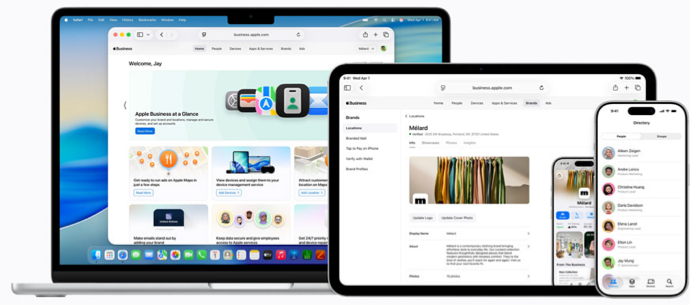
What Apple Business Actually Includes
The platform brings together mobile device management, business email and calendar with custom domain support, and tools to help businesses appear in Apple Maps, Mail, Wallet, and Siri.
Breaking that down into plain English:
- Device management (MDM): IT-style control over iPhones, iPads, and Macs, without needing an IT department. You can push apps to employee devices, lock down settings, and wipe a lost phone remotely. Apple calls its setup templates “Blueprints,” which let you configure a new device so it is ready to use straight out of the box.
- Business email and calendar: Businesses can bring their own custom domain name or purchase a new one through Apple Business, so your team gets proper yourname@yourcompany.com addresses rather than iCloud.com addresses.
- Company directory: A built-in contact list so employees can find each other, with calendar delegation for scheduling on someone else’s behalf.
- Brand tools: Control how your business appears on Apple Maps, Safari, Spotlight, and in the Mail app, including photos, hours, and special offers.
The Catch: You Need Apple’s Newest OS, not yet released
The device management features work now, but the productivity tools that start to make a genuine Microsoft 365 rival are months away.
An important ‘gotcha’ is buried in the fine print (literally) of Apple’s announcement.
“The Apple Business companion app, along with email, calendar, and directory features, will require iOS 26, iPadOS 26, or macOS 26.
Those operating system versions haven’t even been released yet! Apple typically ships new OS versions in September, following its June developer conference. That means the email and calendar features, the most compelling parts for anyone comparing this to Microsoft 365, will not actually be usable until the northern autumn 2026 at the earliest.
It also means that older but quite serviceable Mac, iPhone or iPad devices which can’t support the ‘2026’ OS releases won’t be able to use Apple Business.
A curiously early announcement
A curious move to announce and sell a product which has major features not available for about six months.
Prospective customers are invited to rearrange these words “horse cart before putting the”.
Three Older Apple Products Are Being Retired
Apple Business Essentials, Apple Business Manager, and Apple Business Connect will no longer be available once Apple Business launches. If you currently pay for Business Essentials, that monthly charge stops on April 14. Business Connect data, including Maps listing and location details, migrates automatically.
This is a hard cutover, not a gradual transition. If your business relies on any of those three services, mark April 14 in your calendar.
What This Means for You
If you run a small business on Apple hardware: This might be worth a look later in the year if there’s a lot of Apple devices in the organization, those devices are compatible with the 2026 OS versions and once the companion app is released That’s a lot of “IFs”.
Free device management alone used to cost money. Getting business email with your own domain at no base cost is genuinely competitive with what Google and Microsoft charge. But how long will the free offer last?
If you use Microsoft 365 today: Do not panic and do not rush to switch. Apple’s email and collaboration tools are nowhere near as mature as Outlook, Teams, or SharePoint. Apple has no equivalent to Word, Excel, or PowerPoint here. This is a device management and identity platform with email bolted on, not a full Office replacement.
Office.eu: Europe’s New Privacy-First Alternative to Microsoft 365
Microsoft 365 Plans in 2026: Complete Overview of Pricing, Features, and Changes
Microsoft 365 Business Plans Pricing and Inflation
Microsoft 365 Classic Explained: A Lower-Cost, No-AI Subscription Option
Microsoft 365 or Office on the MacBook Neo? What Mac Buyers Should Expect
Microsoft 365 Premium: Copilot AI, New Features and Pricing Explained
Copilot Access Levels for Microsoft 365 Consumer Plans: What You Actually Get
How to Use Apple Handoff with Microsoft 365 for Mac and iOS Devices
How to Buy a Cheaper Microsoft 365 Plan
Welcome Office.EU, a Microsoft 365 Alternative Focused on Data Sovereignty